Ashley
Exploring Alternatives to the Pill: 5 Contraception Options Beyond the Contraceptive Patch

Rebecca Gormley, a newcomer to Love Island, entered the show wearing a visible patch of contraception. This left people wondering if there was a better alternative than the Pill. We evaluate four contraception alternatives
Who is watching the new Love Island winter series? We certainly do, with #bodygoals all around.
You may have seen that the new girl Rebecca Gormley, a former Miss Newcastle, entered the villa on Monday night at 9pm.
Shaughna Philips, a contestant in the show, said that Rebecca had ‘the hair of a god’.
The viewers who were paying attention also noticed that Rebecca, the 21-year old bombshell, was absolutely stunning. But something else caught their eyes too – the visible patch at the top of her right leg.
Viewers noticed a contraceptive on Rebecca’s thigh when she was in the Hideaway on her dates with Callum Jones and Connor Durman.
21 Rebecca Gormley’s contraception patch can be seen on the top left of her thigh. (Picture ITV/Love Island ITV2)
The beauty queen was praised by viewers for her sexual safety and health precautions. We also love that she is promoting contraception!
Many viewers had no idea that there was a contraceptive patch.
The contraceptive patch is also known as Evra in UK. It’s a small, adhesive patch that releases hormones to your body, preventing pregnancy.
It is 99 percent effective in preventing pregnancy. Condoms must still be used when having sex, as it does not protect against STIs.
The Pill is the most popular choice of contraception.
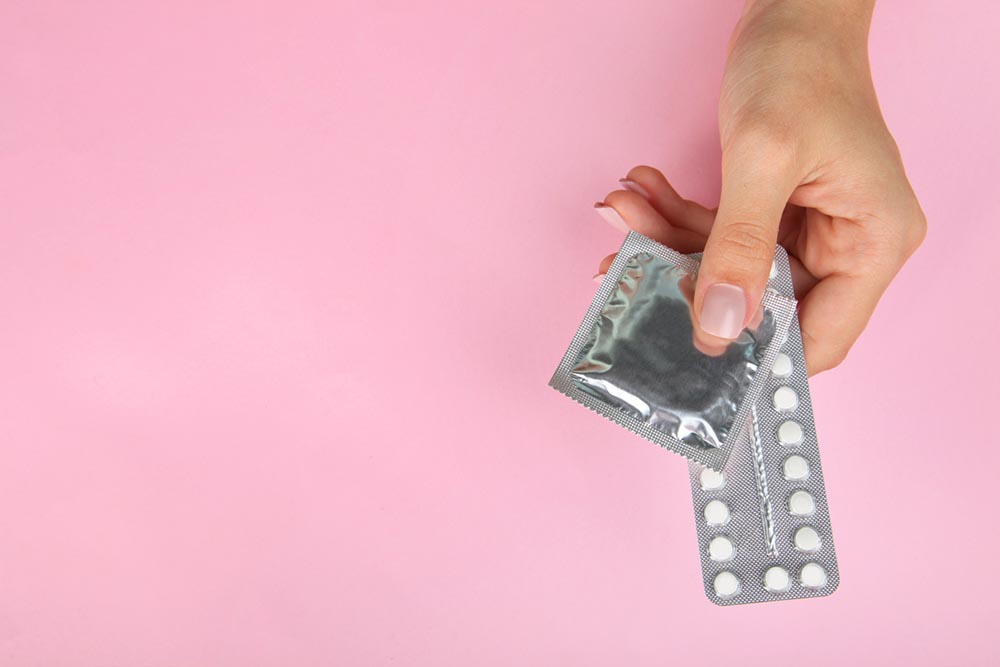
Four million British females take the Pill.
Many people still suffer from the horrible side effects of this disease, including nausea, mood swings and headaches. They may also experience physical changes such as weight gain.
Dr Anne Connelly is a GP and the chair of the Primary Care Women’s Health Forum. She says that some women complain about being moody or spotting.
Some people feel like they are gaining weight or bloated. It’s clear that some Pills cause more side effects than other.
Connolly, a family planning expert, is now encouraging women to look at newer forms that don’t require daily popping.
The Pill is not without its downsides, but it has one major advantage – it can help women prevent certain cancers.
A landmark research has revealed that the Pill may help women prevent certain types of cancer.
The Royal College of General Practitioners conducted research that found women who used the pill at some point in their lives are less likely than others to develop ovarian cancer, endometrial cancer, or colorectal carcinoma. The researchers found no evidence to suggest that the Pill increased cancer risk.
It’s not necessary to rush out and buy a new prescription just because the results are amazing.
What are the alternatives to the Pill for contraception?
One of the 15 types of contraception that are available in Britain is the Pill. According to a study conducted recently, one fifth (25%) did not know the alternatives available.
Three quarters of women had never discussed non-Pill methods with their doctor.
Connolly says that a group of contraceptives known as Long-Acting, Reversible Contraceptives, or LARCs, are not only more effective but also do not require a daily pill.
She explains that LARCS is 99 percent effective, whereas the Pill only has an 8 percent failure rate.
She says, ‘But we find that doctors don’t take the time to inform their patients of their non-Pill options for contraception.’
“The Pill has been a great thing for women over the past 50 years,” says Professor John Guillebaud. He is emeritus family planning professor at University College London, and author of Other Forms Of Hormonal Contraception. (Oxford University Press, PS9.99 on Amazon.
He says that women should look at new contraceptive options, such as the three-year implant placed in the upper arm, or the intrauterine system, which makes periods more comfortable and lighter. “In my opinion, this is the biggest advance in birth-control since the invention the Pill.”
This is a list of free LARC options that you can get from your GP…
The Patch is also known as the Evra Patch
PROBLEM: ‘I get heavy, painful periods’
Try the Evra patch
Contraceptive patches are small, sticky patches that release hormones through the skin. They prevent pregnancy. The brand name of the patch in the UK is Evra.
The contraceptive patches release a daily dose through the skin to the bloodstream in order to prevent pregnancy.
The combined pill contains the same hormones (oestrogen, progestogen), and it works the same by preventing the release an egg every month (ovulation).
The cervical mucus is also thickened, making it harder for sperms to pass through the cervix following sex. The womb lining thins so that a fertilised ovary is less likely be able implant itself.
The patch can prevent pregnancy in more than 99 percent of cases when used correctly. The patch is only good for one week before it needs to be replaced with a new one. After three weeks of changing the patch each week, you get a week without one.
It’s not necessary to take it every day, like with a pill. And you can still use it if you are sick or diarrhoeal. It is also waterproof, so you won’t need to remove it before going into the water. Wear it while bathing, swimming or playing sports.
The patch has many advantages:
- It has been claimed that the patch also protects against ovarian cancer, womb cancer and bowel carcinoma.
- It is easy to use, and it doesn’t interfere with sex.
- You don’t need to remember it every day like you do with the oral contraceptive pills. Just once a month is enough.
- It still works even if you have diarrhea or vomit.
- You can have a more regular period, with less pain and discomfort.
- It can reduce the risk for fibroids, ovarian cysts and non-cancerous diseases of the breast.
The patch has some disadvantages:
- Some women experience headaches when using the patch.
- You may also need condoms if you are concerned about sexually transmitted diseases (STIs).
Mirena is also known as IUS or coil.
PROBLEM: ‘I get heavy, painful periods’
TRY : The intrauterine system (IUS
The ‘Mirena,’ or Intrauterine System IUS, is a small plastic T-shaped device that is inserted by a physician into the uterus where it releases progestogen.
It secretes tiny amounts of progestogen hormone into the womb. This thickens the cervical mucus, making it harder for sperms to pass through. It lasts for five years.
Pros Fertility returns back to normal after removal. Periods may become lighter, shorter, and less painful. In a single year, Dr Connolly claims that you can reduce period blood loss by 90 percent. It’s local action means less hormone is absorbed into the bloodstream, so side effects tend to be minimal.
Cons If you’ve never had children, or your doctor isn’t very experienced in insertions, you may find it painful. Ask for a local anesthetic and go to a clinic that has experience.
Breast tenderness, headaches and acne, as well as irregular bleeding or spotting are possible. These symptoms usually disappear after six months.
The implant
PROBLEM: ‘I get moody’
Try the implant
The ‘Nexplanon,’ a small hairpin-sized device is placed into the upper arm skin where it releases progestogens for three years.
The copper coil can also be helpful if you are experiencing hormonal mood swings due to the Pill. It contains no hormones.
The device delivers a low-dose progestogen. It is worn for a period of three years. The doctor or family planning nurse inserts and removes the device under local anaesthesia.
ProsYou may use one three weeks after the birth of your baby and while breastfeeding. It could reduce heavy, painful periods. Once removed, fertility returns to normal.
Cons Can cause weight gain and breast tenderness. It can also lead to acne, mood changes, or even irregular bleeding.
The injection
PROBLEM: ‘I get terrible PMS’
Try: The injection
Every eight to thirteen weeks, ‘Depo-Provera,’ or the injection, will be injected in the buttocks. It can also be injected in the arm, leg, or abdomen. It’s only progestogen, so it is suitable for women who are sensitive oestrogen. Unlike the combined Pill it does not affect other medications such as those used to treat epilepsy.
Pros It’s easy to forget about for 8-13 weeks. It can be used while breastfeeding. According to the Family Planning Association it may help reduce heavy and painful periods, as well as symptoms of premenstrual disorder.
Cons This may cause weight gain. According to Dr Connolly many women will experience spotting for up to a year following the use of Depo Provera. After that, most will notice their periods have stopped. After stopping Depo Provera, it can take up to a full year for fertility to return to normal.
Avoid the injection if you are prone to weight gain when using contraception
PROBLEM : “The Pill causes me to gain weight”
TRY : All the LARCS except the injection
Dr Connolly says that there is no evidence to suggest that LARCs cause weight gain except for Depo-Provera injection. She says that one in four women who take it will gain weight.
You can book an appointment with a local family planning clinic if your GP doesn’t want to discuss alternatives to the Pill. The NHS covers all types of contraception, so you don’t need to worry about paying for them. You can download a free app that will help you locate a contraception clinic.